Chair of IPEN awarded Political Studies Association Sir Isaiah Berlin Prize

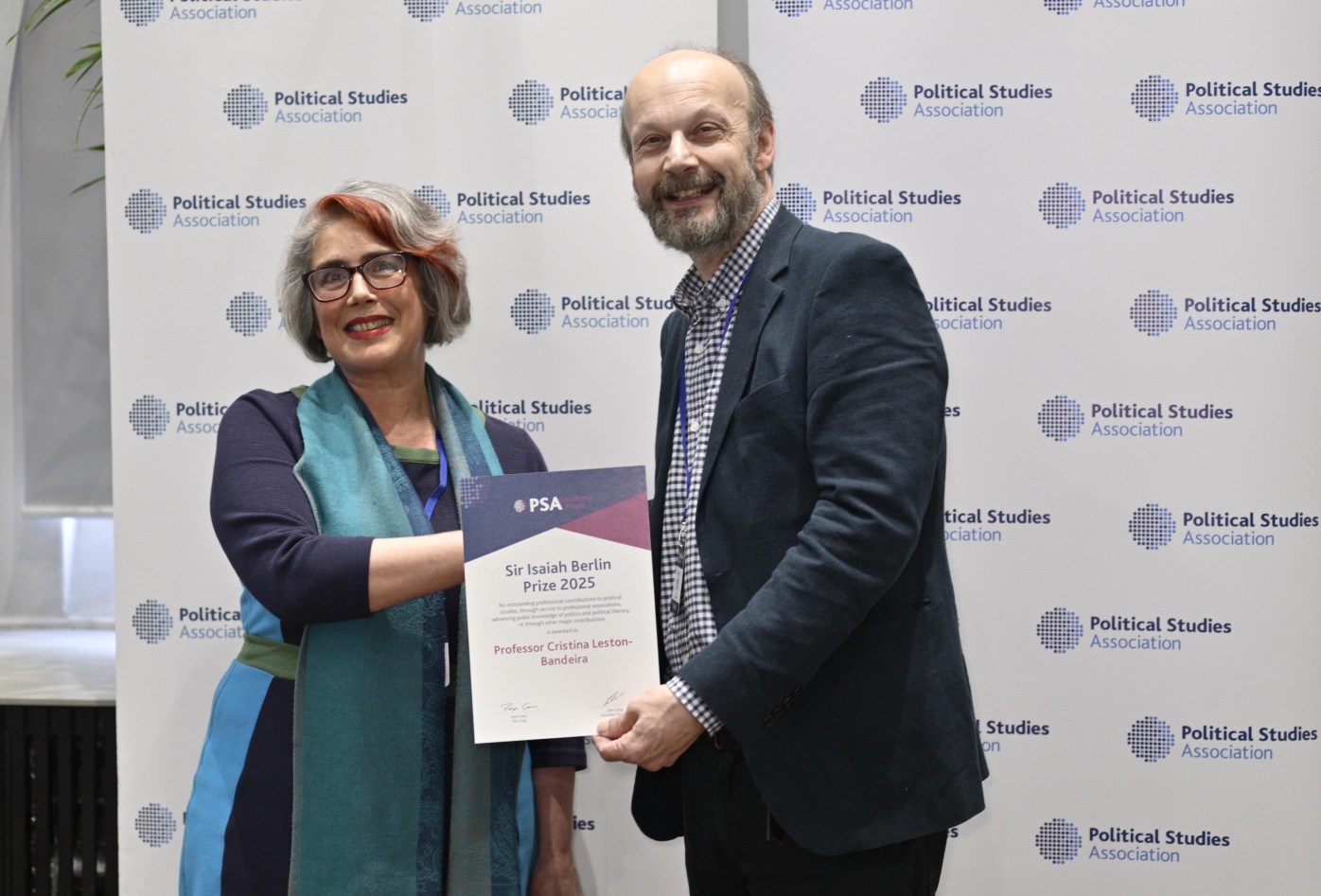
Cristina Leston-Bandeira – Professor of Politics at the University of Leeds and Chair of IPEN – has been awarded the Sir Isaiah Berlin Prize 2025 ‘for outstanding professional contributions to political studies’ by the Political Studies Association (PSA).

Founded in 1950, the PSA is a professional association that aims ‘to promote the development of political studies and to encourage education and the advancement of learning in the art and science of government’.

Cristina was recognised for being ‘instrumental in promoting the relationship between parliaments and citizens’ and for ‘her pioneering work on symbolic representation and public engagement’ which has ‘profoundly shaped the subfield of parliamentary and legislative research in the UK and beyond’.

Her work on parliamentary studies and her role as Chair of the International Parliament Engagement Network have particularly helped to advance ‘public knowledge of politics and political literacy’.

Cristina was presented with this year’s Sir Isaiah Berlin Prize at an awards ceremony at the PSA’s 75th Anniversary Annual International Conference in Birmingham, UK, on Monday 14 April.

Image

Cristina Leston-Bandeira receiving the Sir Isaiah Berlin Prize at the PSA’s 75th Anniversary Annual International Conference in Birmingham, UK, on Monday 14 April.

Article published: 26 June 2025

Developing guides on citizen engagement for parliaments

Thursday 17 July 2025

Speakers: Cristina Leston-Bandeira (Professor of Politics at the University of Leeds and Chair of IPEN), Jonathan Murphy (Head of Programmes, INTER PARES) and Juliet Ollard (Senior Research and Engagement Officer at the University of Leeds, on secondment from the UK Parliament Select Committee Public Engagement Team)

Chair: Alisson Bruno Dias de Queiroz (e-Citizenship Program Coordinator at the Brazilian Federal Senate and IPEN Executive Team)

Details: In this IPEN seminar, Cristina Leston Bandeira and Juliet Ollard will reflect on their journey developing a suite of eight Guides on Citizen Engagement for Parliaments, in partnership with INTER PARES. Jonathan Murphy will reflect on the role this type of guides can play.

The Guides draw from research and case studies from around the world and aim to provide a framework and practical tools for parliaments to implement effective and meaningful practice in public engagement.

Cristina and Juliet will present the key features of these guides and reflect on the opportunities and challenges they’ve encountered in developing such a wide ranging suite of guides.

The eight Guides are:

  • Principles of parliamentary public engagement
  • Parliament as a space and place
  • Petitions and citizens’ initiatives
  • Youth engagement
  • Public consultations
  • Education programmes
  • Deliberative engagement
  • Engaging underrepresented groups

This online seminar will take place in MS Teams and is open to members of the International Parliament Engagement Network (IPEN).

Find out more about the network.

Image by Research Retold.

Deliberative democracy ‘check’in’

Six speech and thought bubbles on a blue background

16 July 2025

If you are an IPEN member who uses deliberative democracy methods as part of your role in parliament or academic research, you are invited to join us for our next ‘deliberative democracy check-in’.

The aim of this IPEN group is to provide a safe space for those currently planning or involved in deliberative democracy projects to get together to seek advice, share good ideas and generally provide moral and practical support.

This ‘check-in’ will focus on the recent decision by the Scottish Parliament to agree the next steps towards institutionalising deliberative practices through the use of People’s Panels, and the work behind the scenes in Parliament to achieve this.

There will also be an opportunity for others to give updates on their practice and research.

The ‘check-in’ is chaired by Chris Shaw (Clerk of the Home Affairs Committee, UK House of Commons, and IPEN Executive Team) and will take place in MS Teams.

It is open to IPEN members who might be able to offer the benefit of their experience, or who just want to hear more. Full details about how to register can be found in our MS Teams space.

Find out more about the network.

Image by Ewa Urban from Pixabay

Spotlight on public engagement practice – E-Cidadania uses AI to tag citizen responses in hearings in Brazil

Spotlight

This month we’re putting a spotlight on how interactivity has been enhanced on the Portal e-Cidadania (e-Citizenship Portal) at the Senado Federal (Brazil) with the use of Artificial Intelligence (AI).

The e-Citizenship Program is co-ordinated by IPEN Executive Team member, Alisson Bruno Dias de Queiroz at the Senado Federal. Created in 2012, the portal provides a platform for citizens to propose new ideas for legislation and participate in public hearings. This information is then processed for Senators to consider.

During a recent parliamentary recess, the Portal improved the visualization of citizen participation in interactive events — usually public hearings — held by the Senate over the last eleven years. Now, even questions from citizens answered indirectly during past events are identified and marked in the video of the event.

Servers, outsourced workers and commissioners were involved in the endeavor to use AI to analyze more than 1,800 events held between 2013 and 2024. The scanning of more than 23,000 participations generated a result of more than 2,700 questions identified as answered indirectly.


Alisson Bruno said:

“Questions that are read during the event and answered directly are already marked in the video, at the time they are read or answered. When there are no questions read, so that the event does not go blank, we started this process of marking indirect answers using AI last year.

“With the campaign, we also cover older events, but since it is still a manual process, and sometimes there are 100 to 200 questions at the event, not all of them go through this search.”

The team generates a series of commands, called prompts, so that the AI ​​can compare the questions asked with the transcript of the event. In addition, all results are reviewed by humans before being published on the website.

The objective of the campaign was to provide citizens with clearer feedback on their contributions, encouraging active participation in the legislative process and, thus, promoting the advancement of society through this interaction with the Legislature.

More information

Find out more in this news story on the Senado Federal (Brazil) website.

Watch a recording of one of our Public Engagement Hub webinars from 2023 where Alisson Bruno joins with Rodolfo Vaz (Coordinator of Digital Solutions for Citizens, Brazil) to discuss processing high volumes of inputs from citizen engagement in parliamentary business in Brazil.

Images

1. Image by Gerd Altmann from Pixabay

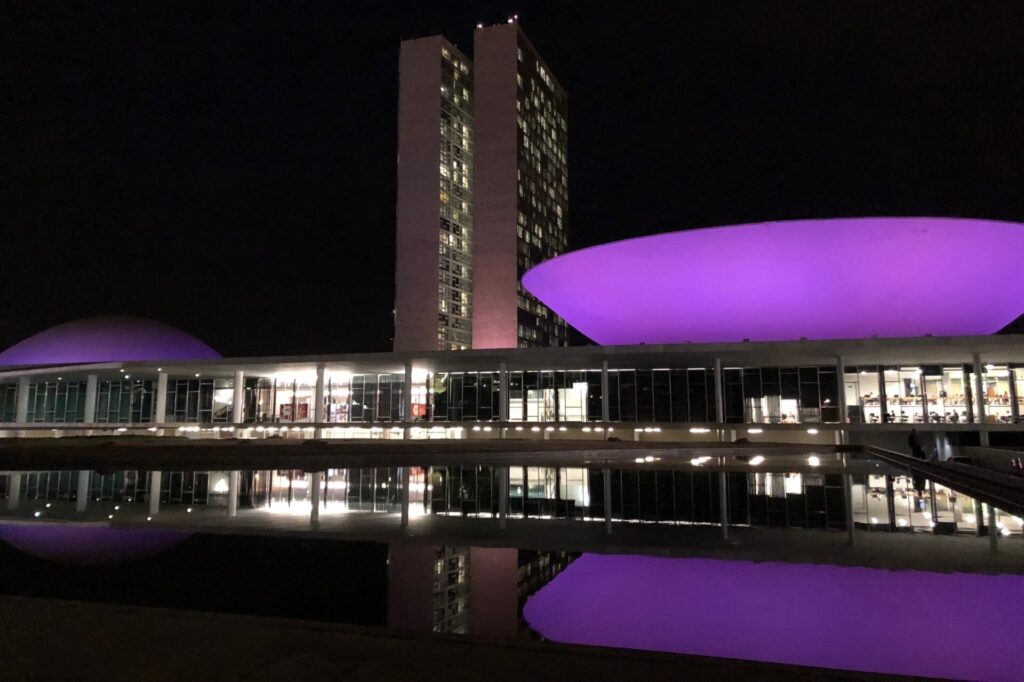
2. Palácio do Congresso Nacional, Brasília, Brazil. Photo by Cristina Leston-Bandeira.

Article published 25 April 2025

IPEN case studies and quick guide on theme of Youth Parliaments now available

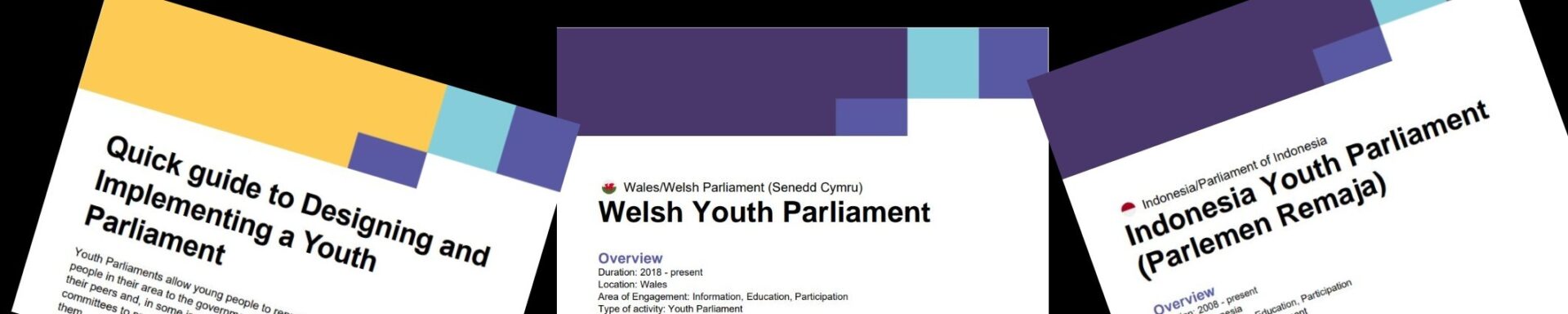
Resources on the theme of Youth Parliaments are now available for members in our IPEN MS Teams space.

They include two case studies, written by Emma Brewis (Postgraduate Researcher at the University of Leeds) alongside IPEN members from the Senedd Cymru (Welsh Parliament) and the Parliament of Indonesia.

Emma has also put together the first of our quick guides which shares insights and tips on setting up and running youth parliaments.

Explore the resources

The following case studies and quick guides can be accessed by IPEN members in the files section of Channel 1.1: Toolkits, Case Studies and Quick Guides in MS Teams:

  • Case Study – Indonesia Youth Parliament
  • Case Study – Welsh Youth Parliament
  • Quick Guide to Youth Parliaments

Create your own case study / quick guide

If you would like to share your work as a case study or are interested in working with us to create more quick guides, then we would love to hear from you. These can be on any theme connected to public engagement with parliament.

More information can be found here on the IPEN website.

Critical Conversation – Youth Parliaments

We’ll be holding our second Critical Conversation event in a couple of months time on the theme of youth parliaments. This event will be open to all IPEN members – please look out in MS Teams and future newsletters for information, date and times.

For these events, we are keen to discuss real life issues and challenges that practitioners face on specific themes related to public engagement with parliament.

If there’s a particular aspect relating to youth parliaments (or anything connected to involving young people in decision making) that you’d like to propose for this event, then please email us at [email protected]. It could be some advice you’re looking for, a particular problem you are trying to solve, or practice you’d like to share.

Join IPEN

If your work or research is connected to youth parliaments, you are very welcome to apply to join the International Parliament Engagement Network (IPEN).

The network brings together academics, parliamentary officials and third sector representatives from across the world, to promote collaboration and encourage knowledge sharing around parliaments and public engagement.

Find out more and join IPEN.

Images

1. IPEN case studies and quick guide on the theme of Youth Parliaments.

2. Welsh Youth Parliament Residential in the Chamber, 26 November 2022 Senedd Ieuenctid Cymru, Gyfarfod Preswyl yn y Siambr, 26 Tachwedd 2022. Licensed under the Creative Commons Attribution 2.0 Generic license.

3. IPEN brings together academics, parliamentary officials and third sector representatives from across the world.

Page published on 25 April 2025

Second edition of Exploring Parliament edited by IPEN members has been published

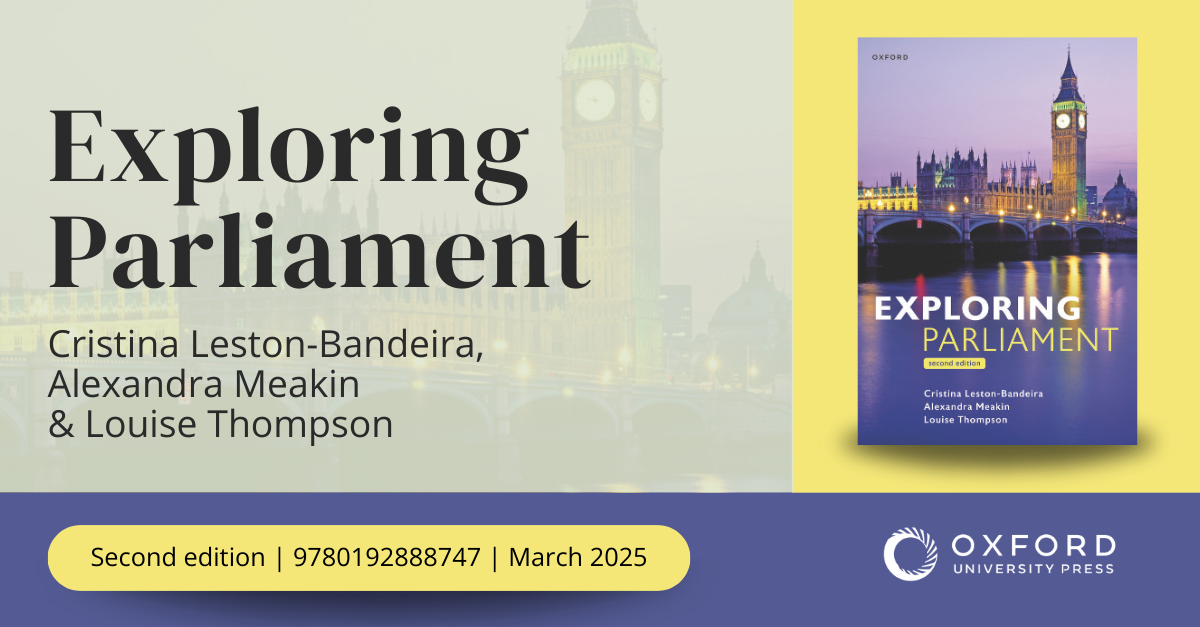
The second edition of Exploring Parliament – a textbook providing an engaging and accessible introduction to the UK Parliament – has been published by Oxford University Press.
 
Exploring Parliament is edited by IPEN members Professor Cristina Leston Bandeira (University of Leeds), Dr Alexandra Meakin (University of Leeds) and Dr Louise Thompson (University of Manchester). The book includes contributions from 73 authors – a mix of academics and practitioners, including many members of IPEN.
 
Exploring Parliament brings in theory, combined with practice, through a series of short chapters accompanied by case studies which make the subject come to life, plus features such as a glossary of parliamentary terms.

Four of the chapters are specifically relevant to IPEN’s focus, on spaces and places, the media, public engagement and trust.

Exploring Parliament – book launch event

Exploring Parliament will be launched at a hybrid event on Thursday 15 May, starting at 17:30 GMT+1 / UK time.
 
At this event, the editors will make opening remarks, reflecting on the book’s unique approach. A panel of the book’s authors will discuss their chapters and insights, followed by a Q&A session.
 
The event will be chaired by Dr Hannah White, Director and CEO at the Institute for Government.
  
Book your place to attend the book launch online.

Book to attend in person.

Find out more about the second edition of Exploring Parliament on the Oxford University Press website.

About the editors

Professor Cristina Leston-Bandeira is a Professor of Politics at the University of Leeds. She has worked on parliaments for nearly 30 years. She is Chair of the International Parliament Engagement Network and a previous Chair of the UK Study of Parliament Group (2019-22). Professor Leston-Bandeira’s research focuses on public engagement with parliament, having published widely on the topic and having secured funding from the AHRC, the British Academy, ESRC and the Leverhulme Trust. She regularly gives evidence to parliaments on public engagement, having held a fellowship with the Petitions Committee of the UK House of Commons in 2016-17. She is the recipient of numerous awards recognizing the quality and innovation of her teaching, including a Higher Education Academy National Teaching Fellowship (2012) and the Political Studies Association Bernard Crick Main Prize for Outstanding Teaching (2010).

Dr Alexandra Meakin is Lecturer in British Politics at the University of Leeds. Her research focuses on parliamentary governance and the plans to repair the buildings of the UK Parliament (known as the Restoration and Renewal of the Palace of Westminster). Dr Meakin’s PhD ‘Understanding the Restoration and Renewal of the Palace of Westminster: A case study of institutional change in the UK Parliament’ was awarded by the University of Sheffield in 2019 and received the 2020 Walter Bagehot Prize for best dissertation in the field of government and public administration by the Political Studies Association. She is a member of the Study of Parliament Group and the International Parliament Engagement Network, and a former convenor of the Political Studies Association Specialist Group on Parliaments and Legislatures. Prior to entering academia, Dr Meakin worked for over a decade in Westminster, for select committees in the House of Commons and for MPs.

Dr Louise Thompson is Senior Lecturer in Politics at the University of Manchester. Her research focuses on legislative scrutiny, committees and political parties in the House of Commons. She is the co-editor of Parliamentary Affairs and a POST parliamentary fellow (2024-2025) undertaking research with the UK Commonwealth Parliamentary Association. She was previously the Co-Convenor of the Political Studies Association’s specialist group on Parliaments and Legislatures (2014-2018). In 2022, Dr Thompson was awarded the Political Studies Association’s Richard Rose Prize for a distinctive contribution to the study of British Politics.

Image

Exploring Parliament book, Oxford University Press.

Article published: 24 April 2025

Last chance to have your country listed in the new global map of public engagement

Map of the world

Last year, we launched a survey to create an accessible global map of parliamentary public engagement practice.

The survey is part of a project titled Mapping public engagement in parliaments across the world, developed as a Parliamentary Academic Fellowship through the UK Parliamentary Office of Science and Technology (POST), together with the International Parliament Engagement Network (IPEN).

The map is now coming together and will soon be launched online. Huge thanks to those of you who have contributed by completing a survey to help us understand how different parliaments engage with their citizens.

Coordinating the survey is Dr Laura Sudulich, a Parliamentary Academic Fellow based at the University of Essex. Laura has now created a beta version of the map and is in the final stages of collecting and collating the data.

It’s not too late for details for your parliament to be added. If you have any information you wish to be included in the map, the survey is still open and can be accessed here.

We are interested in including public engagement activity in all parliaments across the world, whether that be national, subnational or supranational.

IPEN members can try out the beta version of the map – to give feedback and check that information you have submitted so far is correct – by accessing it in IPEN’s MS Teams space.

Find out more about the project and survey to create a map of public engagement practice in this news story on the IPEN website.

Image

Image by Clker-Free-Vector-Images from Pixabay

Page published: 23 April 2025

Spotlight on academic research – Australia

Book chapter by Sarah Moulds on the Australian House of Representatives

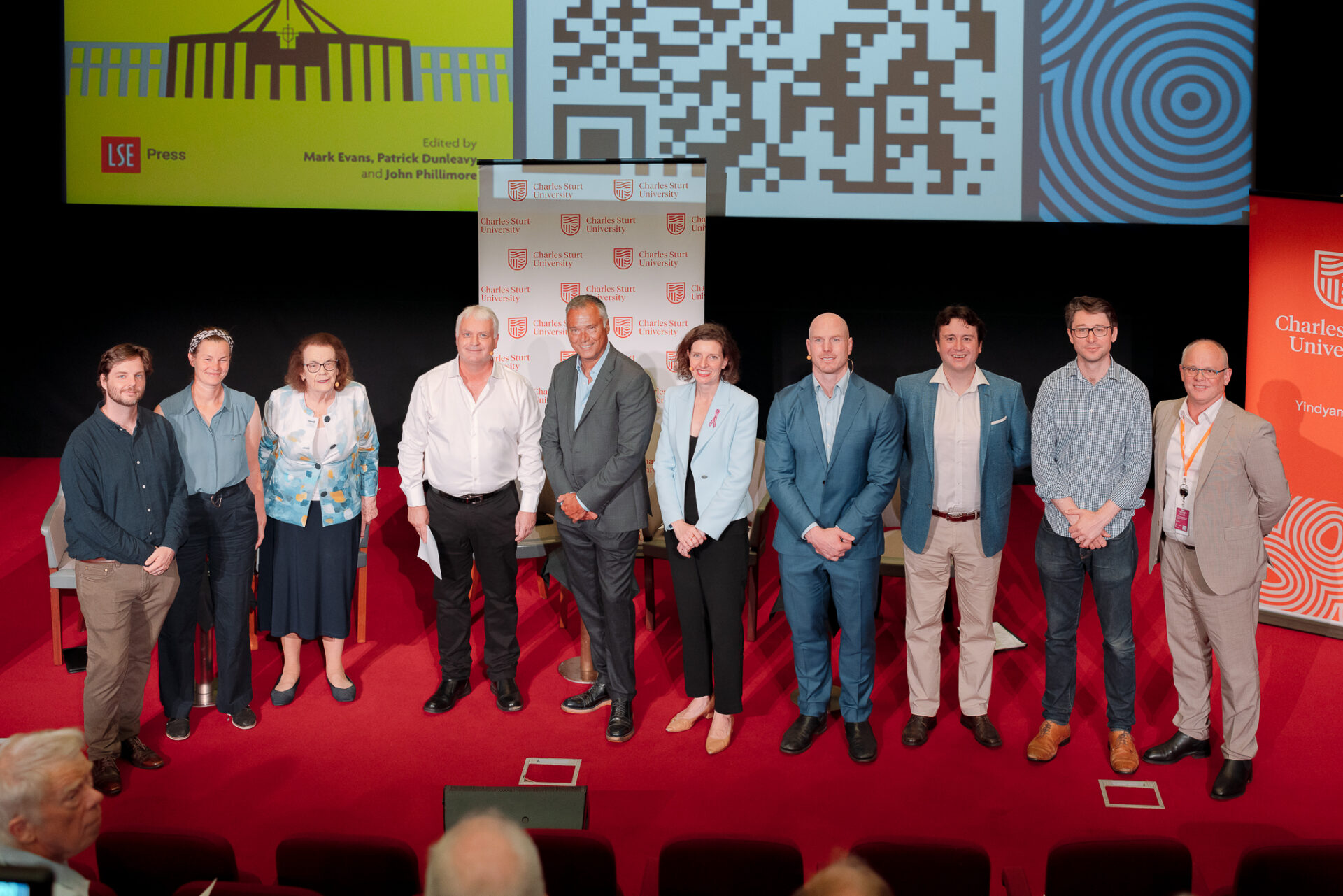
A new book published by LSE Press includes a chapter on the House of Representatives in the Australian Parliament by Dr Sarah Moulds (Associate Professor in Law, University of South Australia and IPEN Deputy Chair).

Edited by Patrick Dunleavy, Mark Evans and John Phillimore, Australia’s Evolving Democracy: A New Democratic Audit uses an audit approach to critically explore Australia’s government institutions, as well as state- and territory-level politics, and to examine how each has contributed to or held back Australian political life as it has changed and diversified.

Sarah’s chapter is one of 28 in the book which covers a range of different aspects of Australia’s democracy, including the protection of human rights, the 2023 Voice to Parliament Referendum, elections and voting, the role of interest groups and mainstream media, and the impact of federalism on lawmaking and policy.

Each chapter outlines recent developments along with an analysis of strengths, weaknesses, opportunities and threats, to fully evaluate the state of Australian democracy in the 21st century. In doing so, the authors draw key lessons for other democracies, showing in detail how robust major and micro-institutions can guard against democratic ‘backsliding’ and policy failures.

This comprehensive audit also highlights scope for potential democratic improvements. Australia continues to confront the challenges of partisan political barriers to addressing climate change and improving the situation of First Nations peoples, redressing modern social inequalities, and responding to popular mistrust of government and politicians.

‘Parliament – the House of Representatives’ by Dr Sarah Moulds was published by LSE Press in Australia’s Evolving Democracy: A New Democratic Audit (Evans, M et al (eds.) on 5 December 2024.

The book and Sarah’s chapter can be found here via open access.

Image

Book launch event for Australia’s Evolving Democracy: A New Democratic Audit.

Article published: 24 April 2025

‘Too Much Engagement? Managing the submission surge’ – New Zealand and New South Wales

New Zealand Parliament building is on the left and on the right hand side is an image of the building of the Parliament of New South Wales in Australia

22 May 2025

Speakers: Dr David Martin Wilson (Clerk of the New Zealand House of Representatives: ‘Clerk of the House’); Stephen Fujiwara (Principal Council Officer, Legislative Council, Parliament of New South Wales) , Jessie Halligan (Principal Council Officer, Legislative Council, Parliament of New South Wales) & Kara McKee (Principal Council Officer Legislative Council, Parliament of New South Wales).

Chair: Dr Sarah Moulds, University of South Australia and Deputy Chair of IPEN

Details: This IPEN seminar will focus on how the Parliament of New Zealand and New South Wales Legislative Council have managed high levels of submissions from the public in connection with public engagement exercises around legislation.

In early 2025, the highly contentious and sensitive issue of changing the Treaty of Waitangi in New Zealand, raised by ACT Party Leader David Seymour MP, prompted an unprecedented wave of public submissions to its Parliament. This coincided with huge Māori protests in New Zealand opposing the proposed changes. Inside the Parliament, extra staff were employed to vet more than 300,000 responses to the Seymour proposal, leading to questions about how to deal with such large volumes in the future. Clerk of the House Dr David Martin Wilson will speak about how the New Zealand parliament managed this experience, and how it intends to approach ‘managing the submission surge’ in the future.

In the second part of the seminar, Stephen Fujiwara, Jessie Halligan and Kara McKee will discuss their experiences managing parliamentary inquiries with thousands of submissions and substantial public interest in the Parliament of New South Wales. Drawing upon three case studies (relating to inquiries concerning reproductive health care, voluntary assisted dying and birth trauma), the speakers will examine the logistical hurdles associated with receiving, reviewing and considering thousands of submissions, managing heightened public and media expectations, and the strain placed on small secretariat teams with limited resources.

Taken together, these insights will be relevant to parliaments around the world struggling with the challenge of ‘managing the submission surge’ whilst continuing to encourage and value public engagement with parliamentary business and processes.

Images:

1. New Zealand Parliament building. Image by Squirrel_photos from Pixabay.

2. Parliament of NSW, Sydney, Australia. Photo by J Bar at the English-language Wikipedia. License: CC BY-SA 3.0.

‘Welcome to IPEN’ – introduction session for new members

13 May

If you have joined the International Parliament Engagement Network in the last six months or so, you should have received an invitation to attend one of our ‘Welcome to IPEN’ sessions on 13 May.

These informal sessions provide members who have recently joined with an opportunity to find out more about IPEN and to meet other new members of the network.

Each welcome session will include introductions, with a chance to ask questions and to share ideas and suggestions. Representatives from IPEN’s Executive Team will also attend to give a quick overview about the network and outline some of the resources and opportunities open to members.

If you have recently joined IPEN and haven’t yet received an invitation, please email us for more details at [email protected].

Find out more about IPEN membership and how to apply.