

Changing of the Guard: Acknowledging Professor Cristina Leston-Bandeira

University portrait photo of Cristina Leston-Bandeira, Professor of Politics and the University of Leeds and Chair of IPEN

By Dr Sarah Moulds (University of Adelaide and Vice-Chair of IPEN)

Leadership transitions provide an opportunity not only to look ahead, but also to reflect on the people whose vision, dedication and leadership have shaped an organisation’s success. As IPEN prepares for a new chapter, it is fitting that we pause to recognise the extraordinary contribution of our outgoing Chair and co-founder, Professor Cristina Leston-Bandeira, whose influence can be seen across every aspect of the network’s development and achievements.

I am thrilled (and slightly daunted by the very large shoes to fill!) to be elected as IPEN’s Vice Chair and, in accordance with IPEN’s governance arrangements, will assume the role of Chair in September 2026. More information about my vision for the future of IPEN is available on our website.

This transition also marks the end of an important chapter in IPEN’s history. Founded in 2020 as a collaboration between the Centre for Democratic Politics at the University of Leeds and the UK House of Commons Service, IPEN was established to create an international community focused on strengthening understanding and practice of parliamentary public engagement. From the outset, Cristina was a driving force behind this vision, helping to build a network that connected academics, parliamentary officials, engagement practitioners and democratic innovators in ways that had rarely been achieved before.
Picture of a globe with diverse people standing on it and the logo of the International Parliament Engagement Network; light blue background.
The International Parliament Engagement Network – a global network

Over the past six years, Cristina has guided IPEN from a promising idea into a thriving international network with a growing global membership and an increasingly influential voice in debates about parliamentary engagement and democratic renewal. Under her leadership, IPEN has expanded its reach across continents, developed a vibrant programme of events and knowledge exchange activities, and created valuable opportunities for collaboration between research and practice.

One of Cristina’s most significant achievements has been her commitment to ensuring that IPEN delivers practical resources that support parliaments around the world. A particularly notable example is the publication of IPEN’s Guides on Citizen Engagement for Parliaments, developed in partnership with Inter Pares (and funded by the European Union) which bring together international evidence, expertise and practical lessons to help legislatures strengthen their engagement with citizens. These guides exemplify Cristina’s long-standing belief that research should not simply analyse democratic institutions, but actively contribute to improving them.
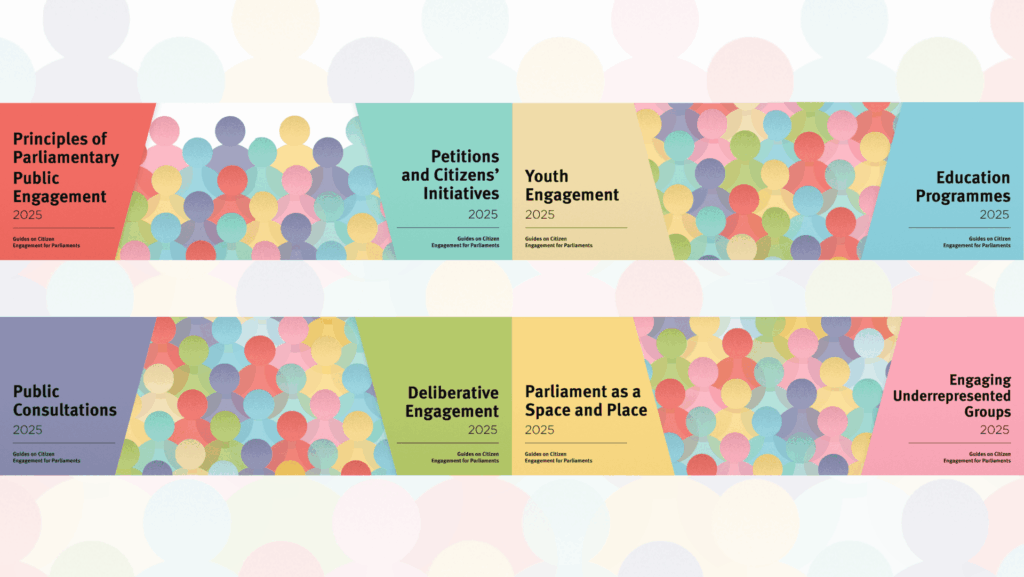
Reproduction of the eight Guides on Citizen Engagement developed by IPEN in partnership with Inter Pares.Visual shows covers of each of the eight guides, which are, briefly, on: Principles of engagement; Petitions; Youth engagement; Education programmes; Consultaitons; Deliberative engagement; Spaces and Places; Underrepresented groups
Guides on Citizen Engagement for Parliaments – Design by ResearchRetold

Cristina has also played a central role in establishing and nurturing strategic partnerships that have enhanced IPEN’s international profile and impact. Between 2022 and 2025, IPEN co-hosted the Public Engagement Hub of the Inter-Parliamentary Union‘s Centre for Innovation in Parliament, creating an important global platform for sharing knowledge and best practice in parliamentary engagement. The Inter-Parliamentary Union remains a valued partner of the network, reflecting the strong relationships that Cristina helped to cultivate. More recently, IPEN welcomed the Westminster Foundation for Democracy as a key partner, opening new opportunities for collaboration and extending the network’s reach even further.

Beyond these tangible achievements, Cristina’s greatest legacy may be the culture she has built within IPEN. Members consistently speak of her generosity, enthusiasm and ability to bring people together around a shared purpose. Whether supporting early-career researchers, connecting practitioners across jurisdictions, or championing innovative ideas, Cristina has fostered a collaborative and inclusive community that has become one of IPEN’s defining strengths.
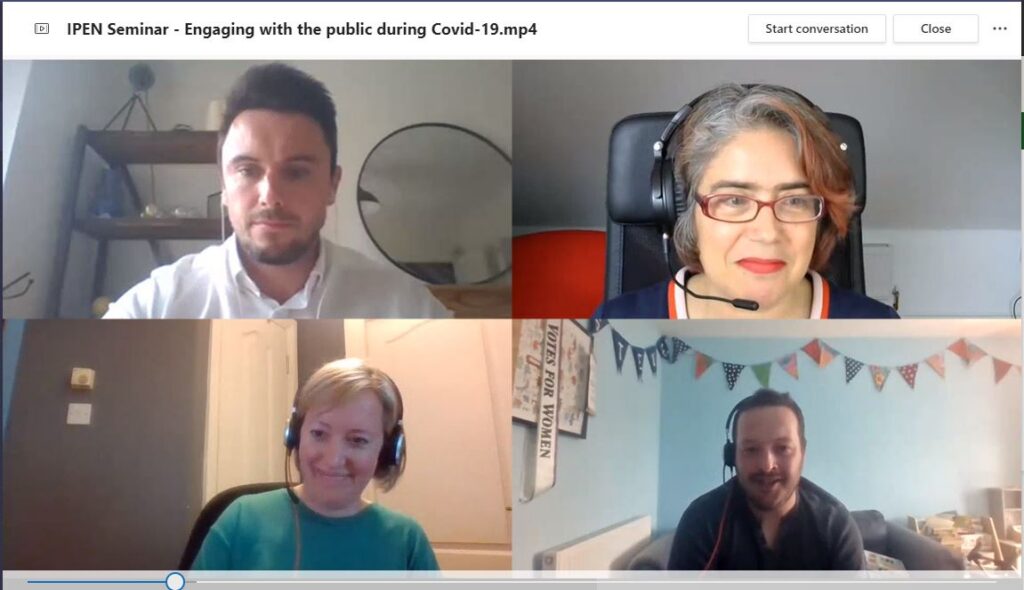
Screen shot of an online seminar, IPEN's first ever, with four speakers: Kevin Davies (Senedd), Cristina Leston-Bandeira (IPEN), Emma McIntosh (Petitions Committee, UK Parliament), Steven Williams (Outreach, UK Parliament)
Cristina chairing IPEN’s first seminar ever, July 2020

Her influence extends beyond the network itself. As a leading scholar of parliamentary studies and public engagement, Cristina’s research and public-facing work have contributed to important conversations about the future of democratic institutions. The growing recognition of both her work and IPEN’s contributions, including references in discussions around parliamentary modernisation and democratic innovation, is testament to the impact of her leadership.

While Cristina is stepping down as Chair from September 2026, the foundations she has created will continue to shape IPEN for many years to come. The network’s growth, reputation, partnerships, practical resources and strong sense of community all reflect her vision and commitment. It is no exaggeration to say that IPEN would not be the organisation it is today without her leadership.

I would like to extend my deepest thanks to Cristina for her outstanding service, leadership and friendship. I look forward to the next chapter of IPEN’s journey, building on the remarkable foundations that Cristina has helped create.

Keep an eye out on Microsoft Teams and LinkedIn for information about how to continue to acknowledge and celebrate Cristina’s contribution.

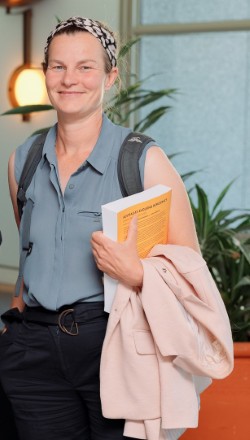
Newly elected Vice-Chair of IPEN: Dr Sarah Moulds

Dr Sarah Moulds

The IPEN Executive Team is pleased to announce that long-time Deputy Chair Dr Sarah Moulds has been elected as IPEN’s Vice Chair.

In line with IPEN’s governance statement, Sarah will take over as Chair in September 2026. We would like to express our heartfelt congratulations to Sarah and look forward to continue working with her in this new role.

We also would like to express our deep gratitude for all that IPEN’s outgoing Chair and co-founder Professor Cristina Leston-Bandeira has done for the network. It is hard to overestimate the role Cristina has played in making IPEN into the force it is today.

We will mark the transition of chairs with a special event in September, expect more on this in the coming months.

Sarah Moulds said:

Dr Sarah Moulds, holding a book and a jacket

“I’m delighted to have been elected Vice Chair of the International Parliament Engagement Network (IPEN). I look forward to taking on this role and taking over as Chair later in the year.

A few words about my work on parliamentary public engagement

For those of you who do not know me, I am an Associate Professor in Law at Adelaide University and co‑founder of the Rights Resource Network South Australia. I have been teaching and researching in the area of public parliament engagement for many years. My work is driven by a simple idea: parliaments work best when they are genuinely connected to the communities they serve.

My training has always been grounded in how rules, institutions, and human experience intersect—particularly where public engagement shapes (and is shaped by) the legislative and law reform process. In my research, teaching, and policy work, I focus on building practical pathways for participation that inform drafting, committee scrutiny, human rights compatibility assessment, and post‑legislative review. This includes working alongside practitioners and community partners to design engagement that genuinely improves the quality and impact of lawmaking.

In 2022, I was honoured to receive a Churchill Fellowship exploring ways to empower young people to engage effectively with Australian parliaments. The resulting report, Connected Parliaments, continues to inform my contributions to IPEN and my broader program of research on democratic renewal and inclusive participation.

My involvement with IPEN

My involvement with IPEN goes back to its beginnings in 2020 and has been one of the most energising parts of my professional life. I’ve learned so much by broadening IPEN’s reach in the Australasian and Pacific regions, including through the Australia–New Zealand–Pacific Islands Community of Practice and in my role as Editor of the Australasian Parliamentary Review, and it has been a privilege to support colleagues to share practice, co‑create resources, and collaborate across jurisdictions.

I’ve seen the powerful, practical impact of the IPEN’s collaborative Guides on Citizen Engagement for Parliaments initiative developed in partnership with Inter Pares, and I am very keen to continue to nurture strategic relationships with organisations such as the Westminster Foundation for Democracy.

A key strand of my professional practice is capacity‑building for parliamentary professionals. I have coordinated and delivered the Parliamentary Law, Practice and Procedure course for colleagues across Australia and New Zealand, helping to translate comparative doctrine and institutional history into practical tools for scrutiny, engagement, and reform. These experiences keep me closely connected to the realities of legislative work and the opportunities to embed meaningful public engagement at every stage of the lawmaking cycle.

Looking ahead

I’m grateful for the leadership, generosity, and mentorship of the IPEN Executive, and in particular, Professor Cristina Leston‑Bandeira. Her example—combining scholarly rigour with inclusivity, curiosity, and collaboration—has shaped IPEN’s culture and my own approach to network leadership.

As Vice Chair of IPEN, I’m excited about the opportunities ahead. I’m committed to supporting IPEN’s members, nurturing new partnerships, and helping the network continue to flourish as a global leader in public engagement. Most of all, I’m looking forward to working collaboratively with colleagues around the world to champion approaches to engagement that are innovative, inclusive, and grounded in real‑world democratic experience.”

The future of IPEN is in good hands

As she steps into the role of Deputy Chair from September onwards, current Chair and co-founder of IPEN, Cristina Leston-Bandeira spoke of her delight of Sarah Moulds’ election as Vice-Chair:

“The International Parliament Engagement Network (IPEN) has been a labour of love to many of us. As I step back from academic roles and the IPEN Chair position, I am delighted with the election of Sarah Moulds as our incoming Chair.

I know that IPEN will be in very good hands with Sarah at its helm. Sarah brings with her not only unique expertise in parliamentary public engagement but also a deep understanding of parliamentary practice – two key ingredients at the core of IPEN.

We are very lucky to have her as our future Chair and I look forward to working with Sarah in this transition to a new stage of IPEN.”

    Call for entries for Elgar Encyclopedia of Parliamentary Studies

    Selective Focus Photography of White Softbound Book

    The Elgar Encyclopedia of Parliamentary Studies is a new project instigated by IPEN members Cristiane Brum Bernardes and Emma Crewe, which aims to work with contributors from around the globe.

    The encyclopedia will provide a background of the literature around parliamentary studies and a theoretical introduction, followed by a range of examples of themes, issues, experiences and structures that are central to parliaments.

    Funded by the European Research Council, the publication will be Open Access and will be of benefit to academics, students and parliaments round the world.

    Experts in legislative studies, ethnography of parliaments, parliamentary communication, digital democracy, political engagement and other related fields are invited to participate in the project by writing entries for the encyclopedia.

    The Elgar Encyclopedia of Parliamentary Studies will explore a list of given themes such as ‘parliamentary committees’ and ‘access to information in parliaments’. Some of the topics yet to be covered include ‘inter-parliamentary bodies and monitoring organisations’ and ‘leaders and leadership’.

    The idea of the encyclopedia came out of the research Global Ethnographies of Parliaments, Politicians and People: representation, relationships and ruptures (EoPPP), coordinated by Emma Crewe (Professor of Anthropology at the School of Oriental and African Studies at the University of London). Cristiane Brum Bernardes – who holds a PhD in Political Science and works as a civil servant at the Brazilian Chamber of Deputies – is responsible for the Brazilian team working on the project.

    Cristiane and Emma said:

    “As much as possible, we would like author representation from across the globe and from different disciplines, whilst acknowledging that we are unlikely to cover all countries and issues comprehensively within the scope of the project.

    “We expect the encyclopedia entries to give an overview of exciting scholarship on the topic, with examples from a range of different parliaments. The idea is to give students and researchers interesting approaches for studying and/or researching parliaments rather than just to provide information and knowledge about parliaments/legislatures.

    “To accomplish this task, we thought a brief theoretical introduction to the topic would be useful to readers, showing the latest and most exciting research being done in different parts of the world.

    “We are putting out a call to others to complement this with some data and insights from their own research, or briefly outline some case studies, narratives or findings to provide some examples and depth.”

    If you are interested in contributing to the Elgar Encyclopedia of Parliamentary Studies, please contact Cristiane or Emma directly by email for further guidelines and a list of topics available: [email protected] and [email protected].

    Article published: 20 July 2023