
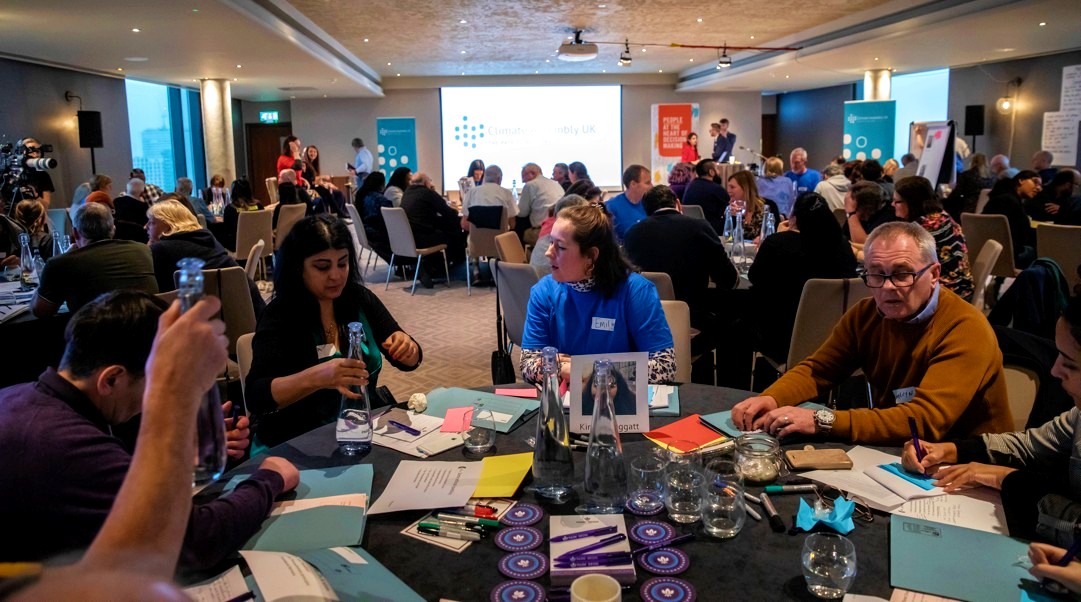
IPEN hosted a seminar last month on the topic of politicisation of deliberative democracy initiatives. The seminar explored arguments around the institutionalisation and the politicisation of deliberative mini-publics, and the relationship between the two.
Our speakers, Professor Alice Moseley and Dr Lise Herman from Exeter University, showed that how the media portrayed the French and UK climate assemblies helped to frame the focus and nature of public discussion of their results.
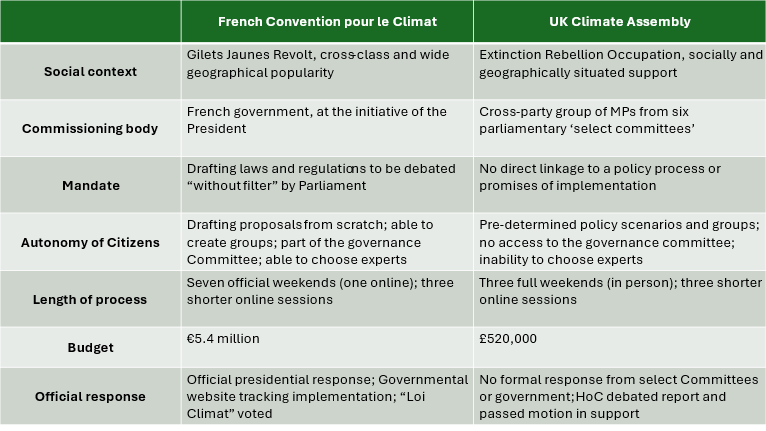
Alice and Lise set out different perspectives around the presentation of deliberative mini-publics (DMPs) as politicised processes. Whilst many commissioners of DMPs sought to frame them as apolitical, the presenters supported the view that politicisation – more public debate and contestation around DMPs – was actually crucial to increasing their effectiveness, not least in allowing the public to challenge existing policies and the status quo. They argued that oppositional media coverage was helpful to increasing public engagement and securing a bigger impact than they currently appeared to achieve. This under-achievement was partly due to their largely ad hoc, rather than institutionalised, nature. In comparing the French and UK climate-based citizens’ assemblies, the presenters set out the differences in media coverage in the context of the more political origins of the French Assembly – established by President Macron’s government – against those of the UK Climate Assembly, which was established by cross-party committees of Parliament.
The speakers summarised the key differences between the two assemblies in Table 1.
Table 1: Explaining differences in politicisation
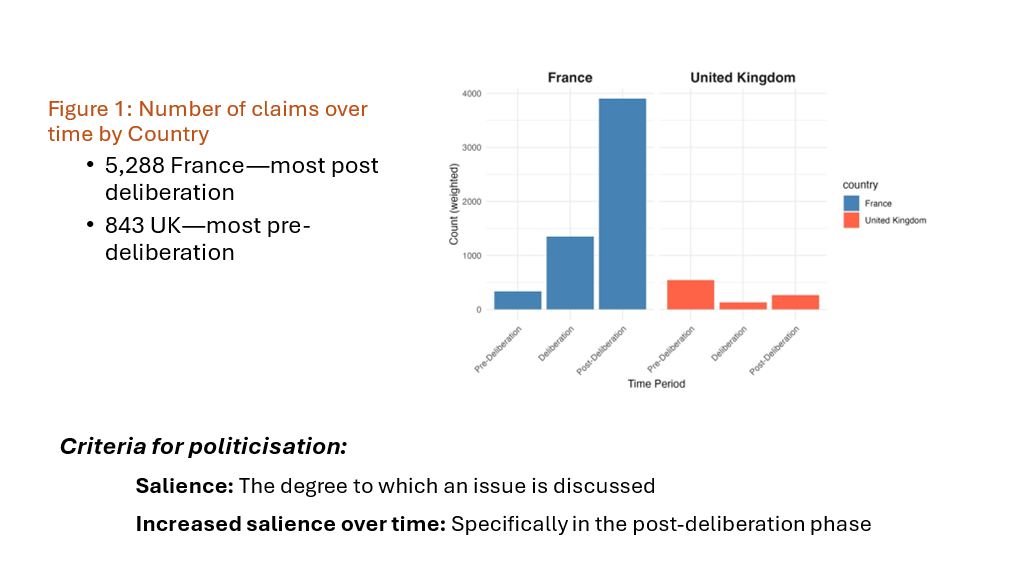
The seminar covered how politicisation was measured and set out how the French Assembly secured more engagement from political actors and more diverse media coverage. The more politicised coverage in the French media focussed more on impact, whilst the UK coverage tended to centre on the process itself.
Ultimately, they argued, if DMPs were properly institutionalised, through law or codification, debate could focus on outputs and citizens might secure more of an agenda-setting role in the choice of subject to be considered.
During a rich subsequent discussion, the importance of the commissioning body was emphasised: only the Government could provide the mandate which could link DMP outcomes to actual decision making. Full transparency with regard to how the outputs would be used was vital for both legitimacy and public confidence.
There was a good discussion around the use of the term “politicisation”, which had a slightly different nuance in a parliamentary than an academic context, but the overall sense was that public debate around DMPs was vital to increase their legitimacy, provided that this didn’t put greater institutionalisation at risk. The cross-party approach to institutionalisation in Scotland was mentioned.
Finally, there was discussion on how regulatory bodies may use DMPs for different purposes, such as evidence gathering, in order to bolster accountability. The seminar was chaired by Chris Shaw, member of the IPEN Executive Board and a clerk in the UK Parliament, and attended by 26 participants, from a range of countries and organisations.