

The IPEN Executive Team is pleased to announce that long-time Deputy Chair Dr Sarah Moulds has been elected as IPEN’s Vice Chair.
In line with IPEN’s governance statement, Sarah will take over as Chair in September 2026. We would like to express our heartfelt congratulations to Sarah and look forward to continue working with her in this new role.
We also would like to express our deep gratitude for all that IPEN’s outgoing Chair and co-founder Professor Cristina Leston-Bandeira has done for the network. It is hard to overestimate the role Cristina has played in making IPEN into the force it is today.
We will mark the transition of chairs with a special event in September, expect more on this in the coming months.
Sarah Moulds said:
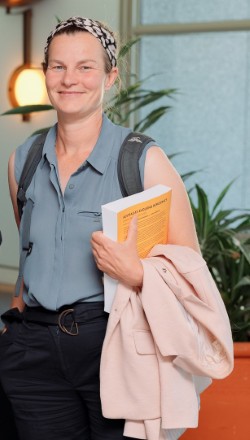
“I’m delighted to have been elected Vice Chair of the International Parliament Engagement Network (IPEN). I look forward to taking on this role and taking over as Chair later in the year.
A few words about my work on parliamentary public engagement
For those of you who do not know me, I am an Associate Professor in Law at Adelaide University and co‑founder of the Rights Resource Network South Australia. I have been teaching and researching in the area of public parliament engagement for many years. My work is driven by a simple idea: parliaments work best when they are genuinely connected to the communities they serve.
My training has always been grounded in how rules, institutions, and human experience intersect—particularly where public engagement shapes (and is shaped by) the legislative and law reform process. In my research, teaching, and policy work, I focus on building practical pathways for participation that inform drafting, committee scrutiny, human rights compatibility assessment, and post‑legislative review. This includes working alongside practitioners and community partners to design engagement that genuinely improves the quality and impact of lawmaking.
In 2022, I was honoured to receive a Churchill Fellowship exploring ways to empower young people to engage effectively with Australian parliaments. The resulting report, Connected Parliaments, continues to inform my contributions to IPEN and my broader program of research on democratic renewal and inclusive participation.
My involvement with IPEN
My involvement with IPEN goes back to its beginnings in 2020 and has been one of the most energising parts of my professional life. I’ve learned so much by broadening IPEN’s reach in the Australasian and Pacific regions, including through the Australia–New Zealand–Pacific Islands Community of Practice and in my role as Editor of the Australasian Parliamentary Review, and it has been a privilege to support colleagues to share practice, co‑create resources, and collaborate across jurisdictions.
I’ve seen the powerful, practical impact of the IPEN’s collaborative Guides on Citizen Engagement for Parliaments initiative developed in partnership with Inter Pares, and I am very keen to continue to nurture strategic relationships with organisations such as the Westminster Foundation for Democracy.
A key strand of my professional practice is capacity‑building for parliamentary professionals. I have coordinated and delivered the Parliamentary Law, Practice and Procedure course for colleagues across Australia and New Zealand, helping to translate comparative doctrine and institutional history into practical tools for scrutiny, engagement, and reform. These experiences keep me closely connected to the realities of legislative work and the opportunities to embed meaningful public engagement at every stage of the lawmaking cycle.
Looking ahead
I’m grateful for the leadership, generosity, and mentorship of the IPEN Executive, and in particular, Professor Cristina Leston‑Bandeira. Her example—combining scholarly rigour with inclusivity, curiosity, and collaboration—has shaped IPEN’s culture and my own approach to network leadership.
As Vice Chair of IPEN, I’m excited about the opportunities ahead. I’m committed to supporting IPEN’s members, nurturing new partnerships, and helping the network continue to flourish as a global leader in public engagement. Most of all, I’m looking forward to working collaboratively with colleagues around the world to champion approaches to engagement that are innovative, inclusive, and grounded in real‑world democratic experience.”
The future of IPEN is in good hands
As she steps into the role of Deputy Chair from September onwards, current Chair and co-founder of IPEN, Cristina Leston-Bandeira spoke of her delight of Sarah Moulds’ election as Vice-Chair:
“The International Parliament Engagement Network (IPEN) has been a labour of love to many of us. As I step back from academic roles and the IPEN Chair position, I am delighted with the election of Sarah Moulds as our incoming Chair.
I know that IPEN will be in very good hands with Sarah at its helm. Sarah brings with her not only unique expertise in parliamentary public engagement but also a deep understanding of parliamentary practice – two key ingredients at the core of IPEN.
We are very lucky to have her as our future Chair and I look forward to working with Sarah in this transition to a new stage of IPEN.”